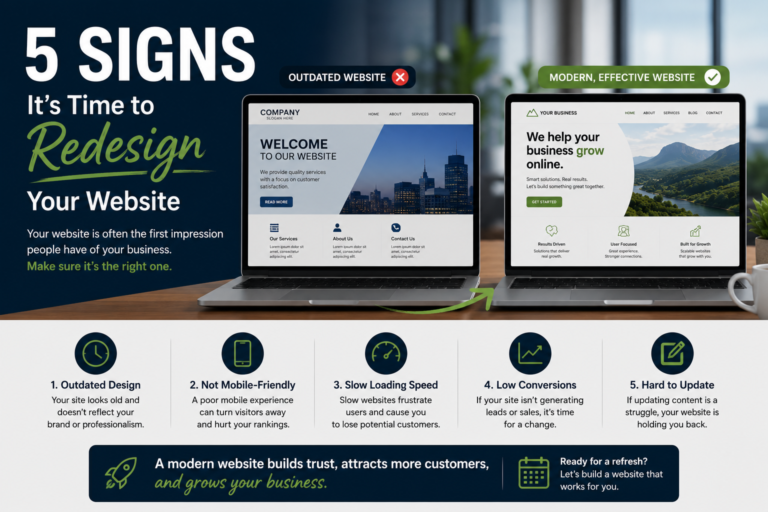
Your website might have looked great the day it launched — but websites age faster than most business owners expect. Design trends shift, technology moves on, and customer expectations keep rising. A site that once felt modern can quietly become a liability, costing you customers without you even realising it.
Here are five clear signs it’s time to consider a redesign.
Your Website Doesn’t Work Properly on Mobile
More people browse the internet on their phones than on desktop computers, and that gap keeps growing. If your website is difficult to navigate on a phone — text too small, buttons hard to tap, images that don’t resize properly — you’re losing a large share of potential customers before they even see what you offer.
Quick test: Open your website on your own phone right now. If you find yourself pinching, zooming, or struggling to tap a button, your customers are experiencing the same frustration.
It’s Slow to Load
Page speed isn’t just a minor inconvenience — it directly affects whether visitors stay or leave, and it’s a ranking factor Google takes seriously. If your site takes more than a few seconds to load, a significant portion of visitors will simply give up and click back to Google to find a competitor instead.
Slow websites are often the result of outdated code, unoptimised images, or older website builders that haven’t kept pace with current standards. A redesign on a modern platform can often fix this dramatically.
The Design Looks Outdated
Web design trends change, and visitors notice — even if they can’t always articulate why a site feels “off.” Common signs of an outdated design include cluttered layouts, small blocky fonts, low-quality or generic stock images, and colour schemes that feel dated.
An outdated website doesn’t just look unpolished — it can quietly undermine trust. If your website looks like it hasn’t been touched in 5+ years, visitors may assume the same about your business: that you’re not active, not current, and possibly not still operating.
It’s Not Generating Enquiries or Sales
This is the big one. A website’s primary job is to support your business — not just exist. If your site isn’t generating phone calls, form submissions, or sales, something isn’t working, whether that’s unclear calls to action, confusing navigation, poor mobile experience, or simply not being found on Google in the first place.
If you genuinely can’t remember the last time a new customer said “I found you online,” that’s a strong signal your website isn’t pulling its weight.
You Can’t Update It Yourself
If making even small changes to your website — updating a phone number, adding a new service, changing a price — requires emailing a developer and waiting days (or longer) for a response, your website is holding your business back. Modern websites, especially those built on WordPress, are designed so business owners can make basic updates themselves, keeping information current without unnecessary delays or costs.
What to Do If You Recognise These Signs
If one or more of these sound familiar, it doesn’t necessarily mean starting from scratch. Depending on your current site, a redesign can range from a full rebuild to a more focused refresh — improving design, speed, and mobile performance while keeping the parts that already work.
The most important first step is getting an honest assessment of where your current site stands, so you know exactly what needs attention.
Final Thoughts
Your website should be one of your hardest-working business assets — generating enquiries, building trust, and representing your brand professionally around the clock. If your current site is showing any of these five signs, it’s likely costing you more in lost opportunities than a redesign would cost to fix.
At Webling Web Design, we help businesses across Nelspruit and Mpumalanga modernise outdated websites — improving design, speed, and mobile performance, while making sure the result is something you can actually manage going forward. Get in touch for a free, no-obligation assessment of your current website.