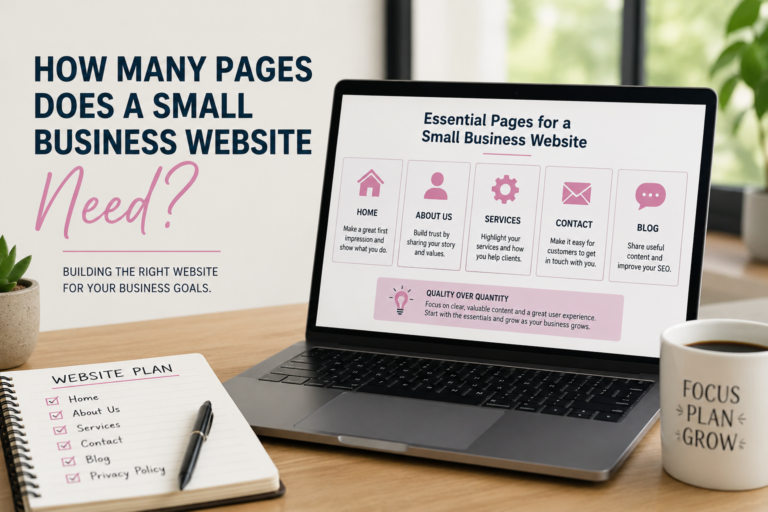
One of the most common questions small business owners ask when planning a new website is: how many pages do I actually need? The honest answer is — it depends on your business. But there are some clear principles that make the decision much easier than it might seem.
The Non-Negotiables — Pages Every Business Website Should Have
Regardless of your industry, size, or budget, these pages form the core of almost every effective small business website:
Home
Your homepage is your first impression and your most visited page. It should immediately communicate who you are, what you do, who you serve, and what you want visitors to do next. Think of it as your shop window — it doesn’t need to contain everything, but it needs to make people want to come inside.
About
People buy from people, especially in smaller communities like Nelspruit / Mbombela. An About page that tells your story, introduces your team, and communicates your values builds the kind of trust that turns browsers into customers. Don’t underestimate how often this page is visited before someone decides to make contact.
Services
A clear, well-structured services page tells visitors exactly what you offer and helps Google understand what your business does. Vague or incomplete service descriptions are one of the most common ways small business websites lose potential customers who arrive interested but leave confused.
Contact
Your contact page should make it as easy as possible for a potential customer to reach you — phone number, email address, physical address if relevant, a simple contact form, and ideally a map. Remove any friction between a visitor deciding they’re interested and actually getting in touch.
These four pages represent the absolute minimum for a credible, functional business website. If budget is tight and you need to start somewhere, start here.
When You Need More Pages
Beyond the core four, additional pages make sense in specific situations:
Separate pages per service
If your business offers multiple distinct services — for example, a company that offers both web design and graphic design — giving each service its own dedicated page is worth doing. It allows you to write more detailed, targeted content for each service, which helps Google rank you for specific searches rather than lumping everything together on one vague services page.
A portfolio or gallery
If your work is visual — architecture, photography, interior design, web design, construction — a portfolio page gives potential clients tangible proof of your capabilities. Seeing real examples of completed work is often the deciding factor for a customer on the fence.
Testimonials
While testimonials work well embedded throughout your site, a dedicated testimonials or reviews page can be valuable for businesses where trust and reputation are central to the buying decision — legal services, healthcare, financial services, and similar industries.
A blog or resources section
A blog isn’t essential for every small business website, but it’s valuable if you want to build long-term visibility on Google. Regularly published, relevant content helps your site rank for a wider range of searches over time and positions you as a knowledgeable, trustworthy business in your field.
Location pages
If your business serves customers across multiple towns or regions — for example, across Nelspruit, White River, and the broader Mpumalanga area — dedicated location pages help Google understand your geographic reach and can significantly improve your visibility in local searches across those areas.
FAQ page
A standalone FAQ page works well for businesses that regularly answer the same questions from potential clients — pricing, turnaround times, processes, guarantees. It saves you time, helps visitors self-qualify, and gives Google additional relevant content to index.
A Practical Guide by Business Type
| Business Type | Recommended Pages |
|---|---|
| Solo freelancer or consultant | Home, About, Services, Contact |
| Trade or service business (plumber, electrician, etc.) | Home, About, Services, Gallery, Testimonials, Contact |
| Retail or product business | Home, About, Products/Shop, Contact |
| Professional services (legal, financial, medical) | Home, About, Services, FAQ, Testimonials, Contact |
| Multi-location or regional business | Home, About, Services, Location pages, Contact |
| Business wanting Google visibility | All of the above + Blog |
More Pages Isn’t Always Better
It’s worth being clear about one common misconception: more pages do not automatically mean a better website or better Google rankings. A website with 20 thin, poorly written pages will almost always perform worse than one with 5 well-structured, detailed pages. Quality and relevance matter far more than volume.
Every page on your website should exist for a reason — either to serve a visitor’s specific need or to help Google understand a specific aspect of your business. Pages that exist simply to bulk out a site without serving either purpose are a waste of effort and can actually dilute your overall SEO performance.
Final Thoughts
For most small businesses in Nelspruit and Mpumalanga, a well-built website of 4 to 6 pages is more than enough to establish a strong, credible online presence and start attracting customers through Google. As your business grows, your website can grow with it — adding service pages, location pages, or a blog when the time is right.
The most important thing isn’t the number of pages — it’s that every page you do have is well-written, clearly structured, and genuinely useful to the person reading it.
At Webling Web Design, we help businesses across Nelspruit and Mpumalanga plan and build websites that are the right size for their needs and budget — not too little, not unnecessarily complicated. Get in touch for a free, no-obligation quote.