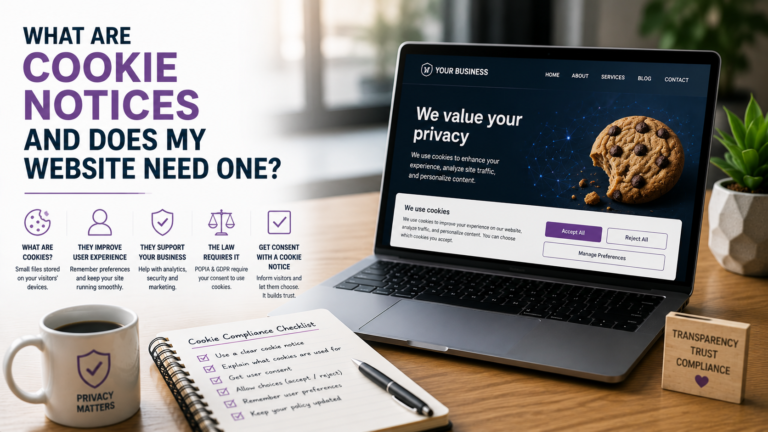
If you’ve ever visited a website and seen a banner at the bottom of the screen saying something like “This website uses cookies” with an Accept button, that’s a cookie notice. You’ve probably clicked through hundreds of them without thinking much about it — but as a business owner with your own website, the question is whether you need one too. Here’s everything you need to know.
What Are Cookies?
Cookies are small text files that a website saves on a visitor’s device (computer, phone, or tablet) when they visit. They’re used for a variety of purposes:
- Essential cookies keep your website functioning correctly — for example, remembering items in a shopping cart or keeping a user logged in.
- Analytics cookies track how visitors use your website — which pages they visit, how long they stay, and where they came from Google Analytics uses cookies to do this.
- Marketing cookies track visitor behaviour across websites to enable targeted advertising — used by platforms like Google Ads and Facebook.
- Preference cookies remember a visitor’s settings, like language or display preferences.
Most WordPress websites use at least some cookies — even without any deliberate setup, plugins like contact form tools, analytics integrations, and the WordPress login system all set cookies by default.
Does Your South African Website Need a Cookie Notice?
Under POPIA and best practice guidelines, yes — if your website uses cookies that collect or process personal information, you should inform visitors of this. Analytics cookies (like Google Analytics) do collect information about visitors, which makes a cookie notice relevant for the vast majority of business websites.
The practical standard for most South African small business websites is to display a simple informational cookie notice that lets visitors know your site uses cookies, with a link to your Privacy Policy for more detail. This covers the transparency requirement without creating unnecessary friction for your visitors.
What Should Your Cookie Notice Say?
For most small South African business websites, a simple notice along the following lines is sufficient:
“This website uses cookies to improve your experience. By continuing to use this site, you agree to our use of cookies. See our Privacy Policy for more information. [Accept]”.
Include a link to your Privacy Policy, which should explain in more detail what cookies your site uses and why.
Do You Need to Get Explicit Consent for Every Cookie?
Strict cookie consent management — where visitors must explicitly accept or reject different categories of cookies before the site loads — is more commonly associated with European GDPR requirements. Under POPIA, the current standard for most South African business websites is transparency and clear notification rather than granular opt-in consent for every cookie type.
That said, best practice is evolving, and implementing a more detailed consent mechanism is never a bad idea — particularly if your business serves international customers or handles sensitive data.
Final Thoughts
Cookie notices don’t need to be complicated. For most small business websites in South Africa, a simple, clear notice with a link to your Privacy Policy covers the transparency requirement and demonstrates responsible data practice to your visitors.
At Webling Web Design, we include a basic cookie notice setup as part of every website we build for clients across Nelspruit and Mpumalanga. Get in touch for a free, no-obligation quote.